National Youth Homelessness Awareness Month | November 2026
Every Young Person Deserves to Feel Seen, Safe & Supported.
When we think about homelessness, we often picture someone sleeping on a sidewalk or seeking shelter from the cold. But for thousands of young people across America, homelessness looks very different.
It may look like a teenager sleeping on a friend’s couch because returning home isn’t safe. A high school student quietly moving between relatives’ homes. A young adult working or attending college while struggling to find a stable place to sleep.
These young people may be sitting in classrooms, playing sports, working part-time jobs, or walking past us every day.
Their struggles aren’t always visible, but their need for support is real.
This November, in recognition of National Youth Homelessness Awareness Month, Project I Am is encouraging communities to look beyond stereotypes, lead with compassion, and take meaningful action.
Youth Homelessness by the Numbers
Youth homelessness is more widespread than many people realize.
Across the United States
- An estimated 4.2 million youth and young adults experience some form of homelessness in a year.
- Approximately 1 in 30 adolescents ages 13–17 experience homelessness over a 12-month period.
- Approximately 1 in 10 young adults ages 18–25 experience homelessness over that same period.
Source: Chapin Hall’s Voices of Youth Count research, as summarized by the National Conference of State Legislatures in 2025.
Closer to Home in Chicago
- 22,438 Chicago Public Schools students were identified as experiencing homelessness during the 2024–2025 school year.
- Approximately 80% of those students were staying temporarily with others because of economic hardship, a situation commonly called doubling up.
- In 2024, an estimated 10,340 unaccompanied young people experienced doubled-up homelessness in Chicago, in addition to young people staying in shelters or living without shelter.
Source: Chicago Coalition to End Homelessness, 2026 reporting.
These numbers remind us that homelessness is not always visible and that many young people are trying to maintain some sense of normalcy while facing extraordinary uncertainty.
How Do Young People Become Homeless?
There is no single reason a young person experiences homelessness.
For some, it begins with family financial hardship, eviction, or the loss of stable housing. Others may leave unsafe homes because of abuse, neglect, or ongoing conflict.
Some young people experience housing instability after leaving foster care or other systems of care without adequate support. Others face family rejection, discrimination, or the loss of a parent or caregiver.
For many, circumstances beyond their control create situations where they must focus on survival instead of simply enjoying their teenage years.
Imagine trying to study for an exam when you don’t know where you’ll sleep that night. Or preparing for a job interview without access to a shower, clean clothes, or reliable transportation.
These are challenges no young person should have to face alone.
Breaking the Myths About Youth Homelessness
Myth #1: If a teenager isn’t sleeping on the street, they aren’t homeless.
Reality: Many young people experiencing homelessness stay temporarily with friends or relatives, move between households, or sleep in other unstable arrangements. Not having a safe, permanent place to live is a serious form of housing insecurity.
Myth #2: Young people become homeless because they choose to leave home.
Reality: Many young people leave because home is unsafe or because family circumstances make stable housing impossible. Even when leaving is a personal decision, it may be a response to circumstances that leave few safe alternatives.
Myth #3: A young person experiencing homelessness can’t be doing well in school or working.
Reality: Students experiencing homelessness can still attend school, earn good grades, participate in extracurricular activities, and hold jobs. Their achievements don’t erase the challenges they face outside the classroom.
Myth #4: Donating a few essential items doesn’t make a difference.
Reality: Hygiene products, clean clothing, and other everyday necessities can help someone meet immediate needs and maintain dignity. These donations are not a substitute for stable housing, but they can provide meaningful support while organizations work toward longer-term solutions.
A Message from Jahkil Jackson: Compassion Starts With Us
As a 19-year-old college student and founder of Project I Am, Jahkil Jackson understands that the challenges facing young people are not always visible.
He founded Project I Am at just eight years old with a simple belief: no one should have to wait until adulthood to make a difference.
A Message from Jahkil
“I think about how much I have going on in my life right now with school, basketball, and just figuring out my future. Then I think about someone my age who is trying to do those same things but doesn’t even know where they’re going to sleep that night.
That’s something that really puts things into perspective for me.
I don’t know what it’s like to experience homelessness personally, but I do know what it’s like to have goals and dreams. Everyone deserves the opportunity to chase those dreams without having to worry about whether they’re safe or where they’re going to stay.
You never know what someone your age might be going through. That’s why I think it’s important to show compassion, not judge people, and help whenever you can. Sometimes something that seems small to you can mean everything to somebody else.”
— Jahkil Jackson, Founder, Project I Am
Turning Awareness Into Action
For 10 years, Project I Am has worked to raise awareness about homelessness while inspiring young people to become compassionate leaders through service.
Through its Blessing Bag initiatives, Project I Am has brought young volunteers together to assemble packages containing essential personal care items for individuals experiencing homelessness and hardship.
This November, Project I Am will be donating essential items to Covenant House Illinois in Chicago, an organization providing shelter, basic necessities, and supportive services to young adults ages 18–24 experiencing homelessness and housing instability.
The donation reflects Project I Am’s ongoing commitment to meeting immediate needs while encouraging young people to recognize the importance of service.
And the work doesn’t stop in November.
On December 1, Project I Am’s annual Giving Tuesday initiative will bring young volunteers together across multiple cities to assemble 10,000 Blessing Bags for individuals in need.
While a Blessing Bag cannot solve homelessness, it can provide essential supplies, offer encouragement, and remind someone that their community cares.
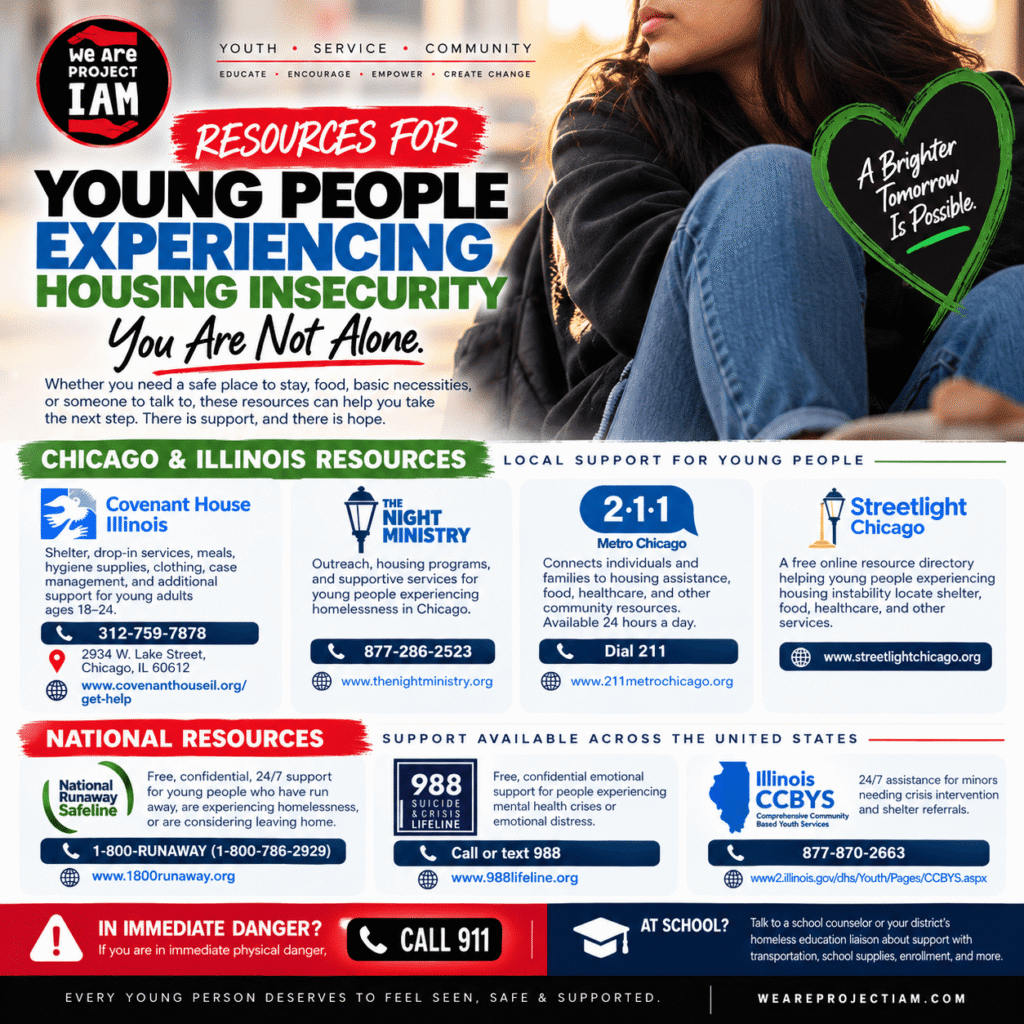
Resources for Young People Experiencing Housing Insecurity
If you or someone you know is experiencing homelessness, struggling to find a safe place to stay, or worried about losing housing, help is available.
Chicago & Illinois Resources
Covenant House Illinois — Chicago
Provides shelter, drop-in services, meals, hygiene supplies, clothing, case management, and additional support for young adults ages 18–24.
- Phone: 312-759-7878
- Address: 2934 W. Lake Street, Chicago, IL 60612
- Website: Get Help from Covenant House Illinois
The Night Ministry
Provides outreach, housing programs, and supportive services for young people experiencing homelessness in Chicago.
- Phone: 877-286-2523
- Website: thenightministry.org
211 Metro Chicago
Connects individuals and families to housing assistance, food, healthcare, and other community resources. Available 24 hours a day.
- Dial: 211
- Website: 211metrochicago.org
Streetlight Chicago
A free online resource directory helping young people experiencing housing instability locate shelter, food, healthcare, and other services.
- Website: streetlightchicago.org
National Resources
National Runaway Safeline
Provides free, confidential, 24/7 support to young people who have run away, are experiencing homelessness, or are considering leaving home.
- Call: 1-800-RUNAWAY (1-800-786-2929)
- Website: 1800runaway.org
988 Suicide & Crisis Lifeline
Provides free, confidential emotional support for people experiencing mental health crises or emotional distress.
- Call or text: 988
- Website: 988lifeline.org
If you are in immediate physical danger, call 911.
Young people attending school can also ask a school counselor or their district’s homeless education liaison about assistance with transportation, school supplies, enrollment, and other educational supports.
Everyone Deserves a Place to Call Home
Youth homelessness is not simply about the absence of a roof. It can affect a young person’s sense of safety, stability, belonging, and hope for the future.
We may not always know what someone is experiencing, but we can choose how we respond.
We can educate ourselves. We can challenge stereotypes. We can support organizations doing the work. And we can encourage the next generation to lead with empathy.
As Project I Am celebrates a decade of service, our message remains the same:
Don’t Wait to Be Great.
You don’t have to be wealthy, famous, or grown up to make a difference.
Sometimes change begins with simply choosing to care.
Learn more about Project I Am and our ongoing initiatives at www.weareprojectiam.com.